Poplar Global Infrastructure
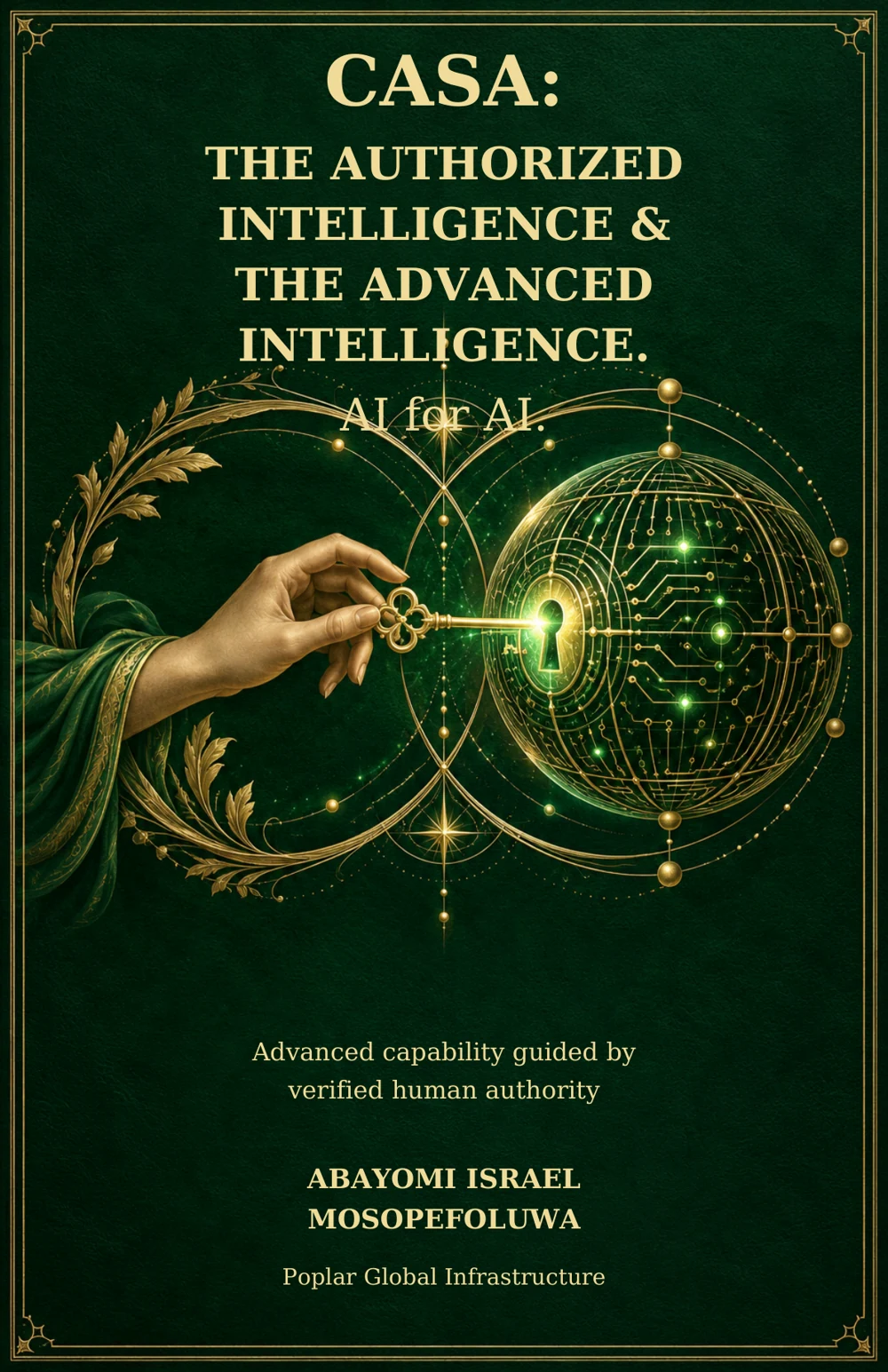
Emerald-green and gold front cover of CASA: The Authorized Intelligence and The Advanced Intelligence. AI for AI.
Front cover · Select to enlarge.

PGI PUBLICATIONS · ENGINEERING & TECHNICAL DETAIL

MANUSCRIPT EDITION · RELEASE COMING SOON

CASA: THE AUTHORIZED INTELLIGENCE & THE ADVANCED INTELLIGENCE. AI for AI.

(Advanced capability guided by verified human authority)

ABAYOMI ISRAEL MOSOPEFOLUWA
Poplar Global Infrastructure

166 pages including covers in the fixed PDF edition · 26 connected chapters
Author review manuscript · 23 October 2026 · CASA-CAT-0165

Advanced capability can discover what is possible. Verified human authority must determine what may be done.

AI for AI means Authorized Intelligence for Advanced Intelligence: useful reasoning connected to legitimate human purpose, bounded permission and accountable effect.

PRICE ON APPLICATIONEngineering and technical editions are quoted individually. Ebook, audiobook and translation releases are coming soon. Applications request pricing and availability review.

Public cover and summary previews. Full manuscript delivery and rental access are not open. No payment or preorder deposit is collected.
From capability to accountable action

A 166-page manuscript developing “AI for AI” as Authorized Intelligence for Advanced Intelligence. Across 26 connected chapters, ABAYOMI ISRAEL MOSOPEFOLUWA follows the relationship from human purpose and verified identity through policy, intelligible approval, effect binding, controlled execution, deadlines, revocation, recovery and accountable evidence. The book explains CASA — Constitutional Artificial Systems Architecture — and the proposed WEB4-to-NeXUS4 transition. It references documented in-house simulator successes while preserving their assumptions, unresolved checks and the distinction from live-system validation or independent verification. Illustrative iWayz and institutional workflows connect the architecture to service design. Includes traditional emerald-green front and back covers and a staged implementation roadmap.

Purpose, mandate and policy

Chapters 1–8 distinguish capability from permission, explain CASA’s proposed development path, and connect human authority to requirements, architecture, identity and bounded policy.

Approval, execution and withdrawal

Chapters 9–15 follow intelligible approval and exact-action binding through execution, deadlines, revocation, freshness, recovery and supervisor failure.

Evidence and its boundaries

Chapters 16–21 examine the recorded in-house campaigns, unresolved isolation checks, proposed bypass tests, privacy, receipts and cross-operator coordination.

Service design and next milestones

Chapters 22–26 develop illustrative iWayz and institutional workflows, governance responsibilities, a staged roadmap and the complete outward and accountability flows.

With reference to in-house testing successes

The manuscript discusses recorded simulator behavior in persistent suspension, authority-generation separation, queued-request expiry, selected approval-binding checks and conditional rollback detection. It distinguishes those observations from proposed future capabilities.

The cited reports retain operational release on HOLD. They do not establish live advanced-AI control, independent verification or production readiness. Detailed reports and raw evidence remain restricted. Use the existing testing-report application process for a defined review request.

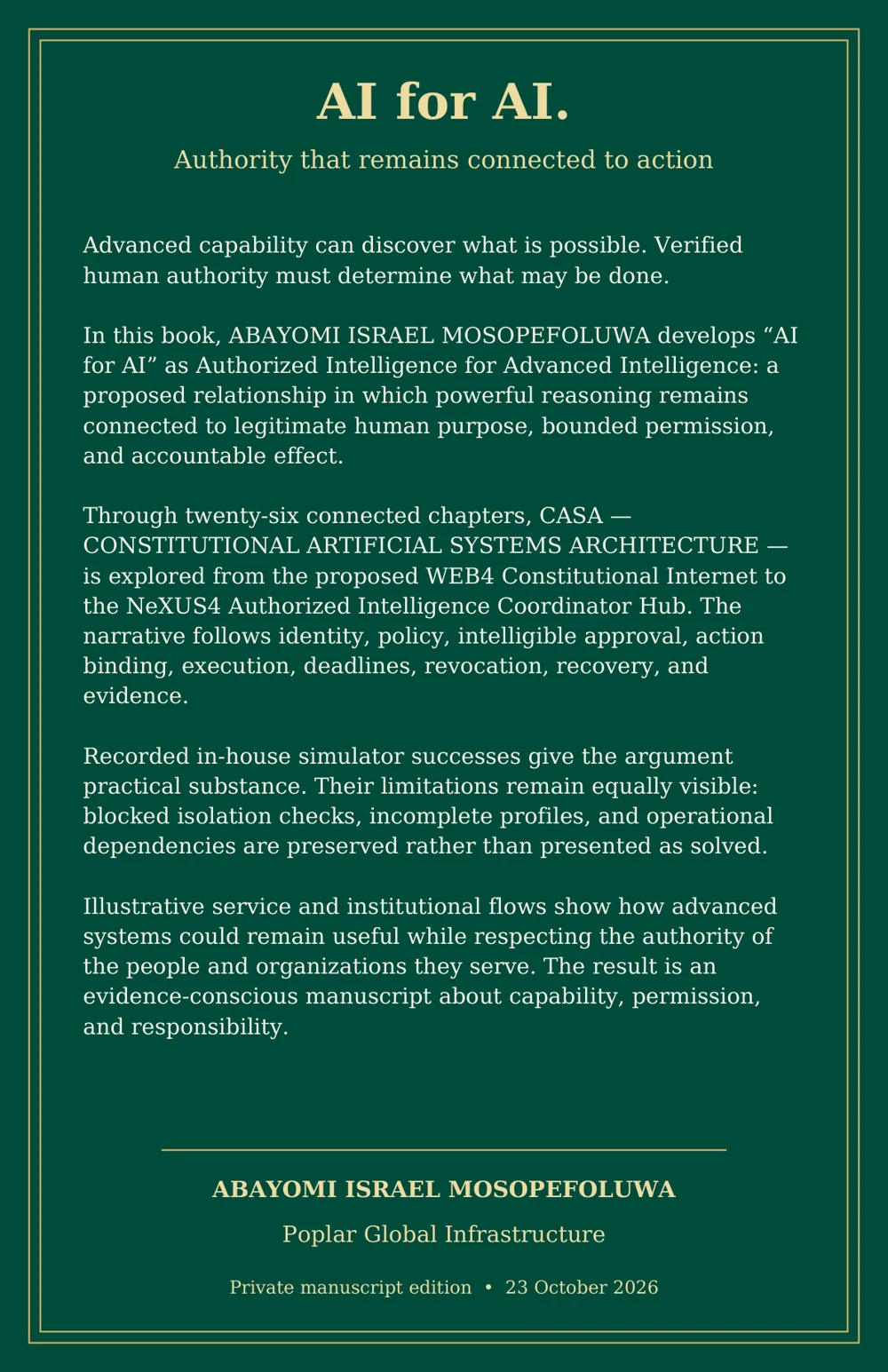
The back-cover summary

Advanced capability can discover what is possible. Verified human authority must determine what may be done.

In this book, ABAYOMI ISRAEL MOSOPEFOLUWA develops “AI for AI” as Authorized Intelligence for Advanced Intelligence: a proposed relationship in which powerful reasoning remains connected to legitimate human purpose, bounded permission, and accountable effect.

Through twenty-six connected chapters, CASA — CONSTITUTIONAL ARTIFICIAL SYSTEMS ARCHITECTURE — is explored from the proposed WEB4 Constitutional Internet to the NeXUS4 Authorized Intelligence Coordinator Hub. The narrative follows identity, policy, intelligible approval, action binding, execution, deadlines, revocation, recovery, and evidence.

Recorded in-house simulator successes give the argument practical substance. Their limitations remain equally visible: blocked isolation checks, incomplete profiles, and operational dependencies are preserved rather than presented as solved.

Illustrative service and institutional flows show how advanced systems could remain useful while respecting the authority of the people and organizations they serve. The result is an evidence-conscious manuscript about capability, permission, and responsibility.

Request pricing and release details
Emerald-green back cover with the AI for AI book summary and author credit
Back cover · Select to enlarge.